

Should You Plan Water Treatment for a Custom Home?
By David K
8 min read

Do not make whole-house water treatment an automatic custom-home upgrade. First identify whether the property will use Charlotte Water or a private well, review the utility report or obtain appropriate laboratory results, and define the exact concern: drinking-water taste, a measured contaminant, hardness, sediment, or another condition. Then decide whether treatment belongs at one drinking-water tap or at the home's point of entry. A point-of-use system can avoid treating water that does not need it; a whole-house system may be appropriate when the condition affects water throughout the home. In either case, coordinate the selected equipment before plumbing rough-in so flow, pressure, bypasses, drains, power, leak protection, replacement clearance, and future sampling are not improvised after the mechanical room is finished.
Planning a new home? Explore Max Built's custom-home process, then view the craftsmanship in our project portfolio.
Begin with the water source and a specific treatment goal
A water-treatment plan should begin with evidence, not a package of equipment. For a home on Charlotte Water, review the current Consumer Confidence Report and the utility's current water-quality information. Charlotte Water reports that its 2025 drinking water met state and federal standards with no water-quality violations. That does not answer every household preference or every condition inside private plumbing, but it does mean a builder should not imply that every city-water home needs additional treatment for safety.
For a private well, the homeowner is responsible for ongoing water quality. CDC advises well owners to test at least annually for total coliforms, nitrates, total dissolved solids, and pH, and to ask local health or environmental officials about other concerns relevant to the area. Use a state-certified laboratory and collect samples according to its instructions. If treatment is installed for a measured concern, plan follow-up sampling so performance is verified at the tap rather than assumed from the equipment label.
Write the treatment objective in plain terms. Is the goal to change taste or odor, reduce a specific contaminant found in testing, manage hardness or scale, remove sediment, or support a private-well treatment strategy? Those goals call for different technologies. EPA notes that taste and smell alone do not necessarily show that water is unsafe, and that no single home treatment system removes every contaminant.
- Will the home use a public water system or a private well?
- What current report or certified laboratory result defines the concern?
- Is the goal health-related, aesthetic, equipment-related, or a combination?
- How will the treated water be tested and the result recorded?
Choose point-of-use or point-of-entry treatment deliberately
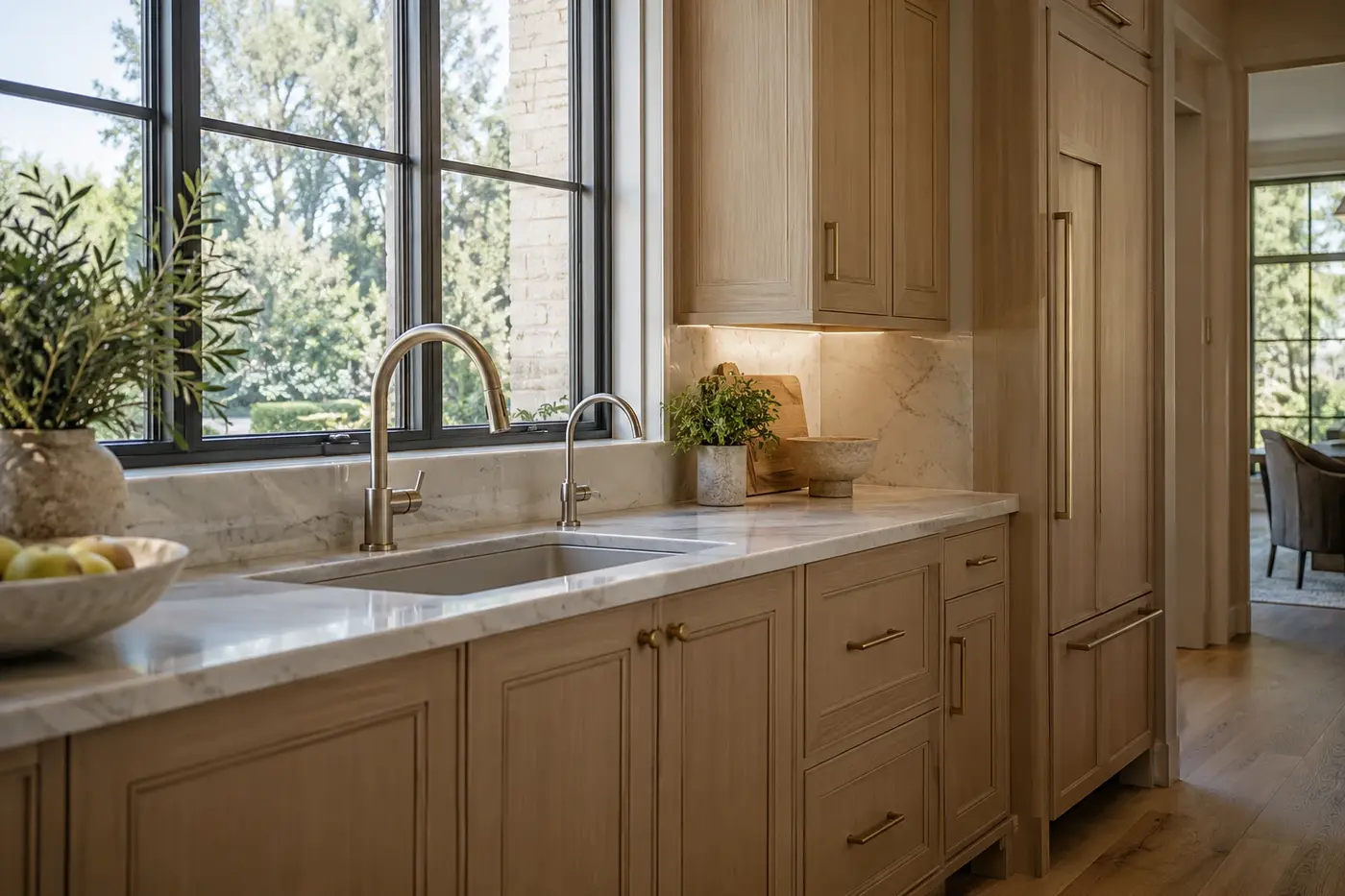
Point-of-use treatment serves one location, such as a dedicated drinking-water faucet at the kitchen sink. EPA's WaterSense guide says this approach is suited to water used for drinking and cooking. It can be a focused choice when the treatment goal does not justify sending every gallon used for toilets, laundry, bathing, and outdoor uses through the same equipment.
Point-of-entry treatment is installed where water enters the home and treats the supply distributed throughout the house. EPA describes it as best suited to situations in which the source poses consistent and significant treatment challenges. Whole-house treatment must accommodate the home's peak flow without creating an unacceptable pressure loss, and its waste, backwash, regeneration, or maintenance needs depend on the selected technology.
Some homes use both scales: a point-of-entry system for a documented whole-house condition and a point-of-use device for a narrower drinking-water goal. Do not combine technologies by habit. Map which fixtures receive treated water, which uses can remain untreated, and what happens during maintenance or a bypass condition. Keep irrigation, exterior hose connections, pools, and specialty equipment in that conversation so treatment is not applied where it adds no value or creates an operating conflict.
Match certified performance to the condition you need to address
A standard number is not a promise that a device removes every substance covered by that standard. NSF explains that manufacturers select the contaminant-reduction claims for certification. Check the product's current listing and performance data sheet for the specific claim, capacity, flow rate, replacement interval, and operating conditions that match the treatment goal.
Common residential technologies have different jobs. Filtration may address sediment, taste, odor, or particular certified contaminant claims. A softener addresses hardness through ion exchange; it is not a universal drinking-water purifier. Reverse osmosis can reduce certain dissolved substances, but it creates a reject-water stream and needs membrane and filter service. Ultraviolet equipment addresses microorganisms under defined conditions, not dissolved chemicals. The incoming water chemistry may also determine whether pretreatment is required.
EPA's current WaterSense guide recommends avoiding oversized treatment because larger systems can cost more to purchase, operate, and maintain. Size the selected system for the fixtures it actually serves, the measured water conditions, the home's design flow, and the manufacturer's requirements. Have the responsible water-treatment and plumbing professionals confirm that the proposed combination will work as one system rather than a row of unrelated devices.
Design the installation for bypass, drainage, pressure, and replacement
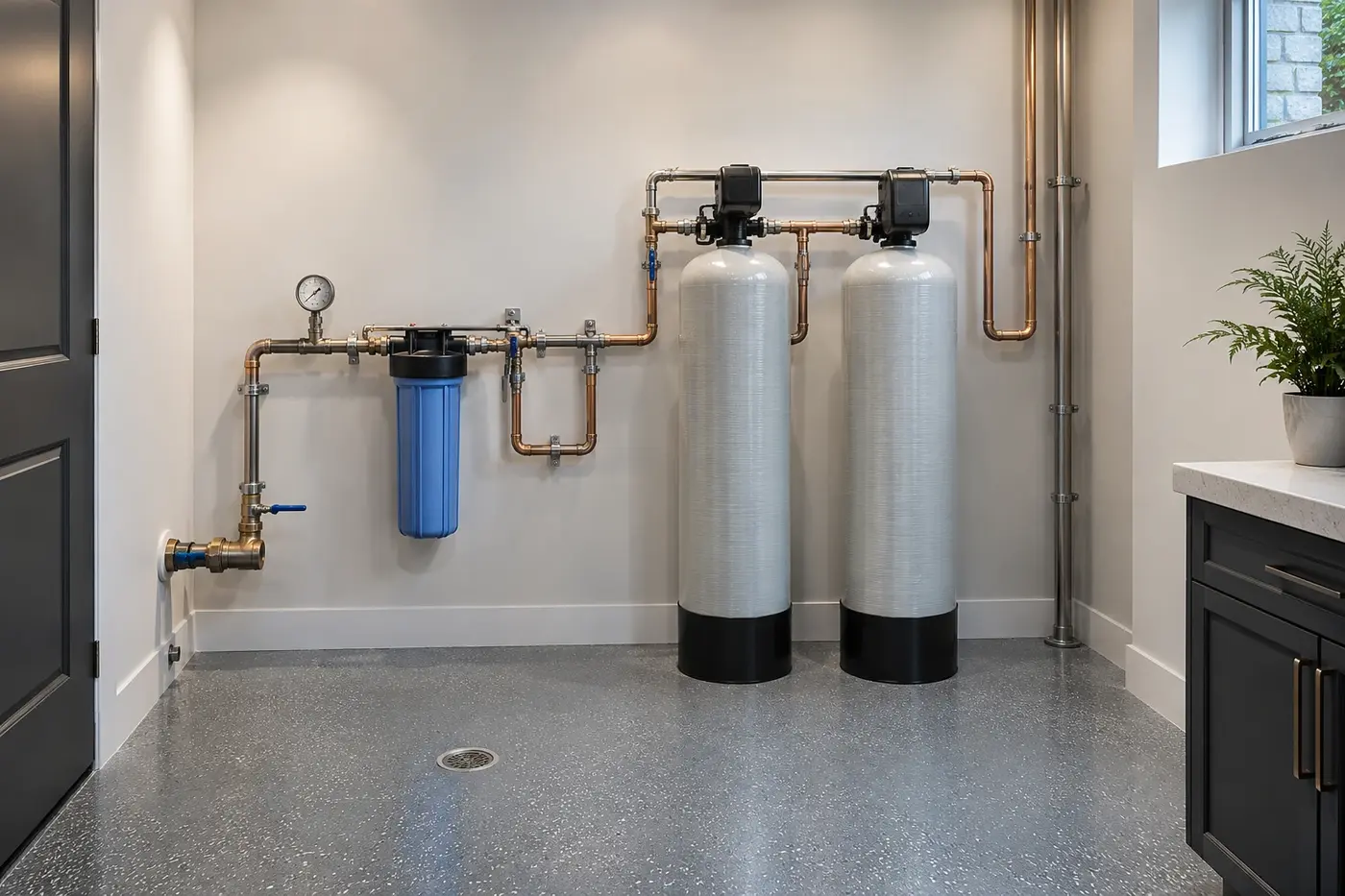
Draw the equipment at its real size before the plumbing plan is released. Show the incoming service, accessible main shutoff, pressure control when required, sample ports, isolation valves, bypass arrangement, filters, tanks, dedicated treated-water branches, backflow protection when applicable, and the route to every served fixture. Charlotte Water notes that the home's master shutoff is normally on the house side of the meter and that a licensed plumber should evaluate pressure-reducing needs; treatment equipment should not make those basic controls hard to reach.
Reserve the utilities each technology needs. Backwashing or regenerating equipment needs an approved drain path and air-gap arrangement where required. Reverse-osmosis systems need a reject-water connection. Powered controls, pumps, monitors, and ultraviolet equipment need coordinated electrical service. Put leak detection or a containment strategy where a failure could damage finished rooms, but do not let a shallow pan substitute for a properly designed drain and shutoff response.
Service clearance is part of the floor plan. Leave room to remove filter housings, exchange media tanks, lift salt or consumables safely, reach valves and controls, and move replacement equipment through the door. Protect the equipment from freezing, impact, excessive heat, and storage that blocks access. A treatment system hidden behind built-ins may look tidy on move-in day and become unserviceable at the first filter change.
Plan commissioning and maintenance before move-in
The closeout should prove more than water flowing from a faucet. Record the untreated and treated sampling points, initial water-quality information, model numbers, certified reduction claims, design flow, pressure readings where relevant, control settings, bypass position, drain operation, and any startup or sanitation procedure. For a health-related treatment goal, use the qualified testing and follow-up process recommended by the responsible public-health or water professional.
Create a maintenance schedule that names the filter, membrane, lamp, media, salt, cleaning, backwash, inspection, and testing tasks that apply to the installed system. EPA warns that unmaintained treatment can become ineffective and may make water quality worse. Store replacement part numbers, service contacts, manuals, certification records, warranties, and baseline test results with the home's other building-system documents.
Also show the homeowner what normal operation looks like: where the main shutoff and bypass are, which faucet supplies point-of-use water, how an alarm or leak shutoff behaves, which drains should discharge during a cycle, and what condition requires a service call or new laboratory test. Max Built can help coordinate these choices with the custom-home plumbing plan, mechanical-room layout, cabinetry, electrical work, and closeout documents before finished construction limits the options.
Sources and editorial notes
EPA WaterSense Guide to Selecting Water Treatment Systems
Charlotte Water quality information and current Consumer Confidence Report
NSF home water treatment system selection guidance
CDC guidelines for testing private well water
Charlotte Water pressure, shutoff, and household plumbing guidance
Prepared with AI assistance and editorially reviewed by Sage. Architectural images are illustrative, not documented Max Built projects. This organizational guide does not replace project-specific professional advice.
Custom-home water treatment planning questions
Does every Charlotte custom home need a whole-house water filter?
No. Start with the water source, current utility information or certified test results, and a specific treatment goal. A point-of-use device may be more appropriate when only drinking and cooking water needs treatment; whole-house equipment should address a documented condition that affects water throughout the home.
Is a water softener the same as a water filter?
No. A conventional softener uses ion exchange to address hardness minerals. Filtration, reverse osmosis, ultraviolet treatment, and other technologies perform different jobs. Select equipment for the measured condition and verify the exact certified performance claim rather than treating one device as a universal purifier.
Should private well water be tested before selecting treatment?
Yes. Use a state-certified laboratory and ask local health or environmental officials which concerns are relevant to the property. CDC recommends annual testing for total coliforms, nitrates, total dissolved solids, and pH, plus other local concerns. The results should guide treatment and the follow-up testing plan.
What space does whole-house water treatment need?
The answer depends on the selected equipment, but the plan should reserve actual tank and filter dimensions, valve and control access, filter-removal clearance, a replacement route, drainage or reject-water connections, power when needed, leak protection, and space to reach the main shutoff and bypass.
How do you know a treatment system still works after move-in?
Follow the manufacturer's maintenance schedule, keep records of filter, membrane, lamp, media, and sanitation work, watch flow and pressure where relevant, and test treated water at the interval appropriate to the original concern. Equipment presence alone does not verify continued performance.
Build the right plan before construction begins
Tell us about your property, priorities, and the way you want to live. We'll help organize the next decisions around a clear, buildable path.